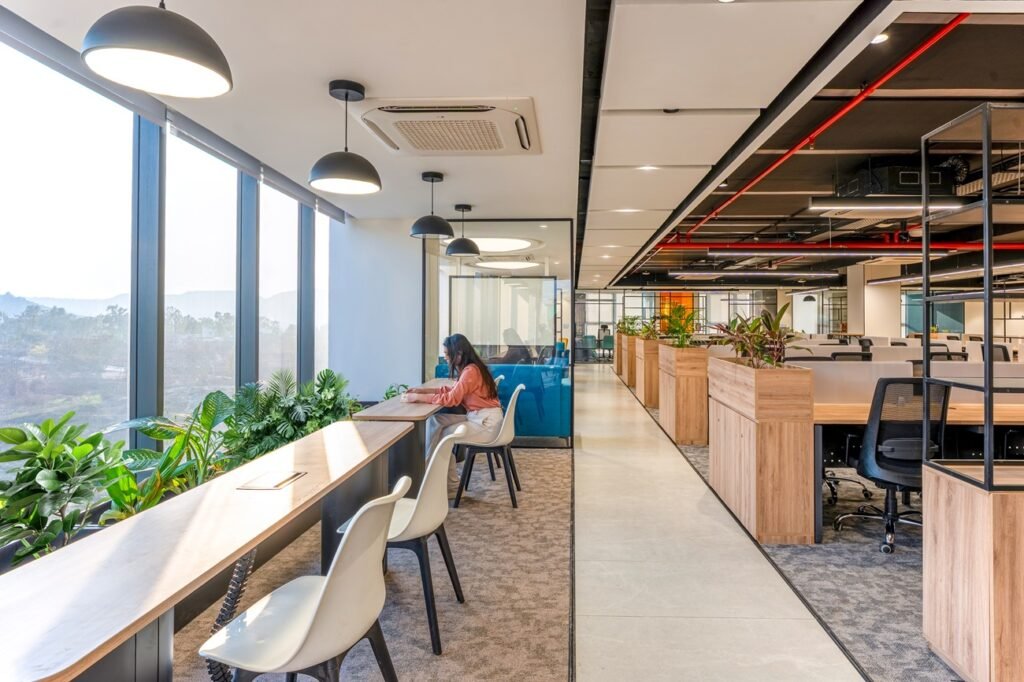


There is a design decision made in nearly every office fit-out that receives less strategic attention than it deserves and it is costing organisations in ways they rarely measure. Poor lighting depresses mood, strains eyes, flattens spatial hierarchy, and erodes the sense of quality that a well-designed workplace is meant to convey. Yet in most office design conversations, lighting is treated as a line item rather than a lever.
The firms that are getting workplace design right, those whose offices genuinely perform as a business asset, understand that lighting is not a utility. It is a design tool with measurable impact on employee experience, space efficiency, and business outcomes. When used with intention, it transforms how a space looks, how it feels, and how effectively it supports the people working within it.
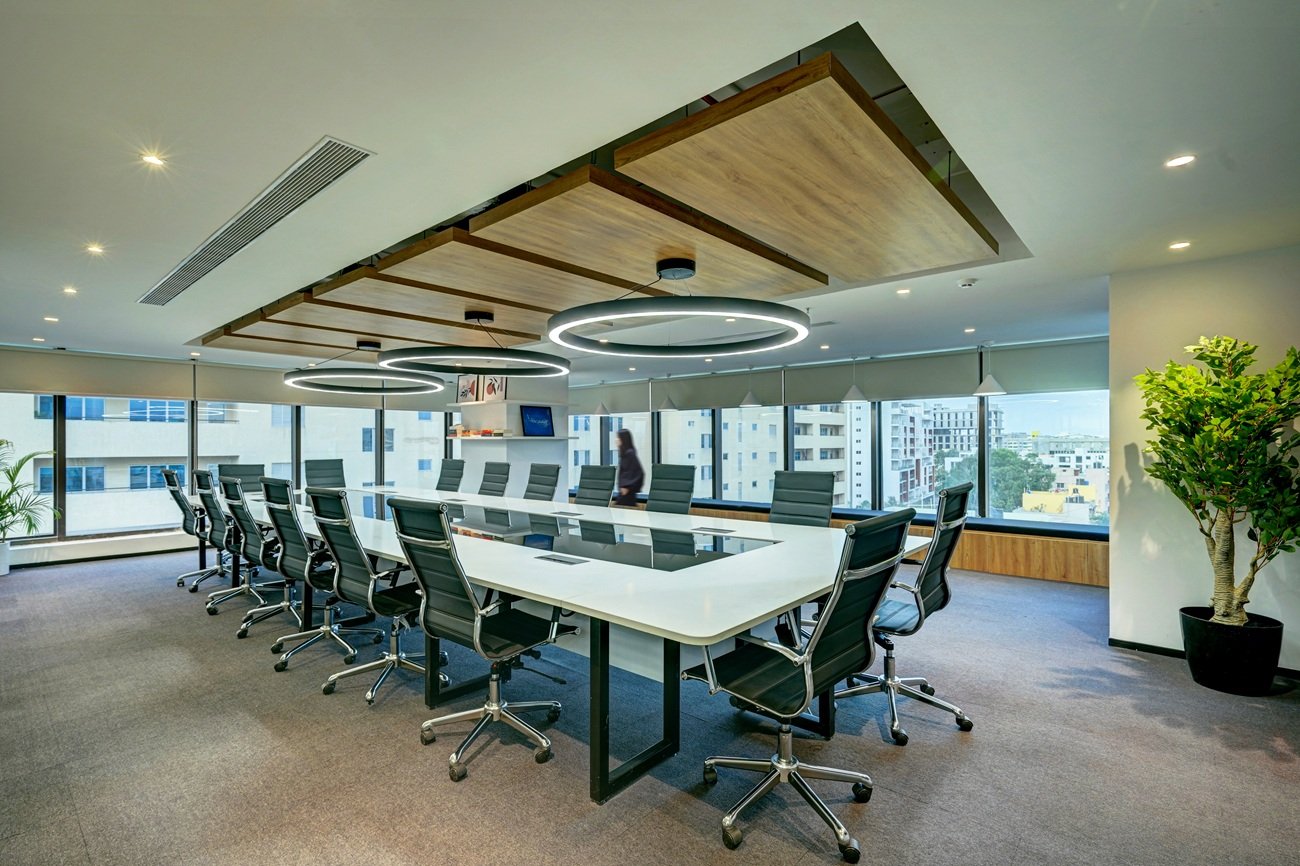
This is what modern workplace strategy looks like when applied to the ceiling.
Why Lighting Is a Workplace Performance Variable
Research in environmental psychology has consistently linked light quality with cognitive performance, circadian health, and psychological well-being. The connection is not subtle. Studies from the World Green Building Council and WELL Building Institute have found that access to appropriate light, calibrated in intensity, colour temperature, and distribution, directly influences alertness, focus, and fatigue recovery.
In the context of commercial interiors, this translates to practical consequences:
- Employees in poorly lit environments report higher rates of eye strain and afternoon fatigue
- Flat, uniform overhead lighting suppresses spatial depth and makes even premium office spaces feel institutional
- Inadequately zoned lighting creates friction in activity-based working environments, where different tasks require different light conditions
- Glare from poorly positioned luminaires undermines screen-based productivity, particularly in open-plan configurations
This is why leading office interior designers now treat lighting as a workplace strategy variable, not a specification to be handed off to MEP consultants without design input.
For a deeper grounding in how natural light interfaces with these dynamics, our analysis on how natural light shapes employee wellbeing offers a useful companion read to what follows.
The Three Layer Lighting Framework
The most effective approach to commercial interior lighting operates across three functional layers, each serving a distinct spatial and experiential purpose.
Layer 1: Ambient Lighting – The Foundation of Spatial Quality
Ambient light sets the base condition of the space. In office design, the instinct is often to maximise brightness uniformly but this is a mistake. Uniform, high-intensity overhead lighting creates visual monotony and eliminates the contrast that makes a space feel considered.
Best practice in workplace design calls for ambient light that:
- Operates at a comfortable average of 300–500 lux for open workstation zones
- Uses indirect or semi-indirect sources to diffuse light without creating harsh shadows
- Incorporates tunable white technology, allowing colour temperature to shift from cooler, alert-promoting tones in the morning to warmer, lower-stimulation conditions in the afternoon
For sustainable workplace environments, LED systems with occupancy sensing and daylight harvesting controls reduce energy consumption by 40–60% over conventional fluorescent installations while simultaneously improving light quality.
Layer 2: Task Lighting – Precision Where It Matters
Task lighting is the layer that most directly supports individual productivity. In open plan and activity-based working environments, where employees move between focus work, collaboration, and informal interaction throughout the day, task lighting must follow function rather than floor plan.
Effective task lighting in a modern office fit-out includes:
- Individual desk luminaires with adjustable positioning and dimming capability
- Under-shelf or integrated panel lighting at workstations that reduces screen glare
- Localised, higher-lux conditions (500–750 lux) at focus and detail-oriented zones
- Pendant task lighting over meeting tables to define zones and direct attention
The distinction between ambient and task layers is what separates a future-ready workplace from a space that merely looks designed. Without task specificity, even a visually attractive office interior will underperform as a productivity environment.
Layer 3: Accent and Architectural Lighting – The Dimension That Signals Quality
This is the layer most commonly underinvested in commercial interiors, and the one with the highest return in terms of perceived spatial quality. Accent and architectural lighting create depth, define brand, and signal the level of design intentionality in a space.
Applications include:
- Cove and reveal lighting to articulate ceiling geometry and add vertical dimension
- Feature pendants and sculptural luminaires at reception, collaboration zones, and breakout areas that function as spatial anchors
- Backlit panels, wash lighting on feature walls, and material-highlighting spotlights that activate texture and surface quality
- Corridor and circulation lighting that creates visual rhythm and aids wayfinding
The psychological effect of well-layered accent lighting is significant. It signals that the organisation has invested thoughtfully in its environment, a message that resonates with employees, clients, and prospective talent alike.
Our work on the impact of creative lighting in modern office interiors explores several of these techniques in applied project contexts.
Integrating Natural and Artificial Light
No lighting strategy for commercial interiors is complete without addressing the relationship between natural and artificial light. The two must work together.
In Pune’s commercial corridors, particularly in developments across Kharadi, Baner, and Viman Nagar, office spaces frequently contend with orientations that deliver high solar gain in the afternoons or deep-plan floor plates where daylight penetration is limited beyond the perimeter zone. The design response in each case is different, but the principle is consistent: artificial light should compensate for what natural light cannot provide, without creating visual dissonance.
A coherent integrated lighting strategy includes:
- Daylight zoning: Grouping workstations by proximity to glazing and controlling ambient levels accordingly via photosensors
- Glare management: Using external shading, fritted glazing, or internal blinds with motorised control to manage direct sun without eliminating views
- Transition lighting: Ensuring that the visual experience shifts gradually between daylit and internally lit zones, preventing the abrupt contrast that causes eye strain and spatial discontinuity
For a detailed treatment of how natural light functions as an active design resource in office space planning, our editorial on the power of natural light in office design provides a strong evidence base and practical framework.
What This Means for Your Office Fit-Out
Lighting decisions made during early-stage office interior design, before the reflected ceiling plan is locked have an outsized impact on how the space performs over its entire occupancy life. Retrofitting lighting quality into a completed fit-out is expensive, disruptive, and rarely delivers the same coherence as a strategy developed from the outset.
When evaluating an office design or turnkey office interior project, the questions worth asking your design partner early are:
- Has lighting been designed across all three functional layers, or only as an ambient specification?
- How does the proposed design manage the transition between natural and artificial light?
- Are controls dimming, zoning, and occupancy sensing integrated into the design or treated as an afterthought?
- Does the lighting strategy support the activity-based working model, or is it configured for a fixed-desk arrangement that the organisation has already moved beyond?
The answers will tell you a great deal about the quality of workplace strategy behind the design.
The Right Light
Lighting is one of the few design decisions in commercial interiors that touches every person in the building, every day, for the full life of the fit-out. It shapes how employees experience the space at 9 AM and how they feel by 4 PM. It signals the quality of the environment to every client or partner who walks through the reception. And it determines, in ways that accumulate over months and years, whether the workplace is an asset to the business or a background condition that barely registers.
Studio AsA designs office interiors across Pune and beyond with lighting as a fully integrated component of workplace strategy, from concept through design to handover. Our turnkey office interior process ensures that every layer of the luminous environment is resolved with the same rigour as the spatial plan.
If you are planning a new office fit-out, a workspace refresh, or a full commercial interior redesign, we invite you to begin the conversation with Studio AsA. Reach out to us to schedule a design consultation.