

Think about the last time you walked into a hotel lobby that stopped you mid-stride.
Maybe it was the light, which was warm and directional, pooling over a cluster of low chairs. Maybe it was the smell, something subtle and deliberate. Or the way the space seemed to know exactly where you should go next, without a single sign telling you to go there. You felt, almost immediately, that someone had thought very hard about you before you arrived.
Now think about the last time a workplace made you feel that way.
For most people, the answer is: it hasn’t. And that gap between what hospitality design has understood for decades and what office interiors have only recently started to grasp is where the most interesting workplace thinking is happening right now.
What Hotelification Actually Means
Hotelification is simply the deliberate borrowing of hospitality logic where the way hotels programme space, sequence experience, and calibrate atmosphere, and apply it to the office.
It emerged from a straightforward problem. After years of hybrid disruption, employees stopped treating the office as a default. They started treating it as a choice. And choices require convincing. The home is comfortable. The cafe has energy. The co-working space has flexibility. The office, in its traditional form, offered none of these things particularly well and offered nothing in return that those other environments couldn’t replicate.
Gensler’s Workplace Survey data has made this case consistently: employees with access to a variety of quality spaces, such as focus zones, social lounges, and collaborative settings, report measurably higher engagement and performance than those confined to a fixed desk in an open plan. The design of the space is not the background. It is a variable that drives outcomes.
Hotelification is the design response to that reality.
The Arrival Moment: Why the First 90 Seconds Matter
Hotels understand something that most offices don’t: the way a space receives you shapes everything that follows.
The check-in sequence in a well-designed hotel, such as the desk height, the lighting temperature, and the surface you rest your hands on while waiting, are considered design element. They exist to perform a very specific psychological function, which is to move you from the noise of travel into a different state of mind.
Office reception areas and lobbies carry the same potential, and squander it with remarkable consistency. A designed arrival zone anchors brand identity through material and light before a single conversation takes place. It orients visitors and employees intuitively, without signage doing the heavy lifting. And critically, it creates the psychological transition that sets the register for the work that follows. Workplace design rooted in human experience makes its most immediate case at this moment; the lobby is the organisation’s opening argument.
A Portfolio of Spaces
Here is something a well-run hotel never does: offer guests one type of room and expect every need to be met by it.
There are suites and singles, terraces and co-working corners, restaurants and quiet bars, pools and reading rooms. The logic is that people come to a hotel in different states, for different purposes, and leave needing different things. Good hospitality design maps to that full spectrum.
The same truth applies to workplace design, and yet the default office still programmes space as if everyone arrives with identical needs at identical hours to do identical kinds of work.
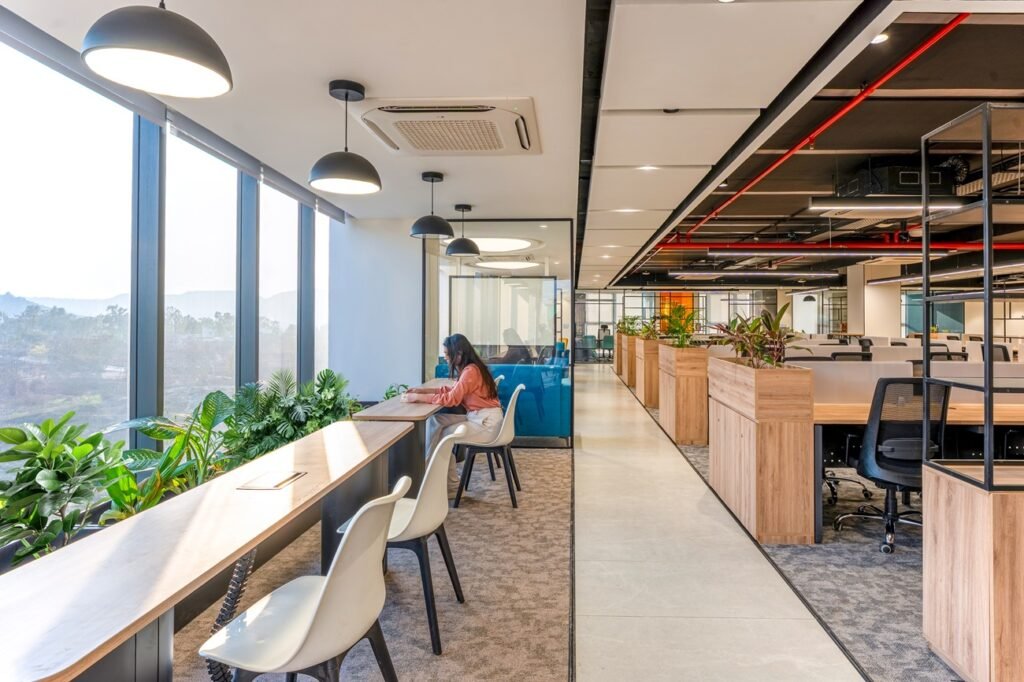
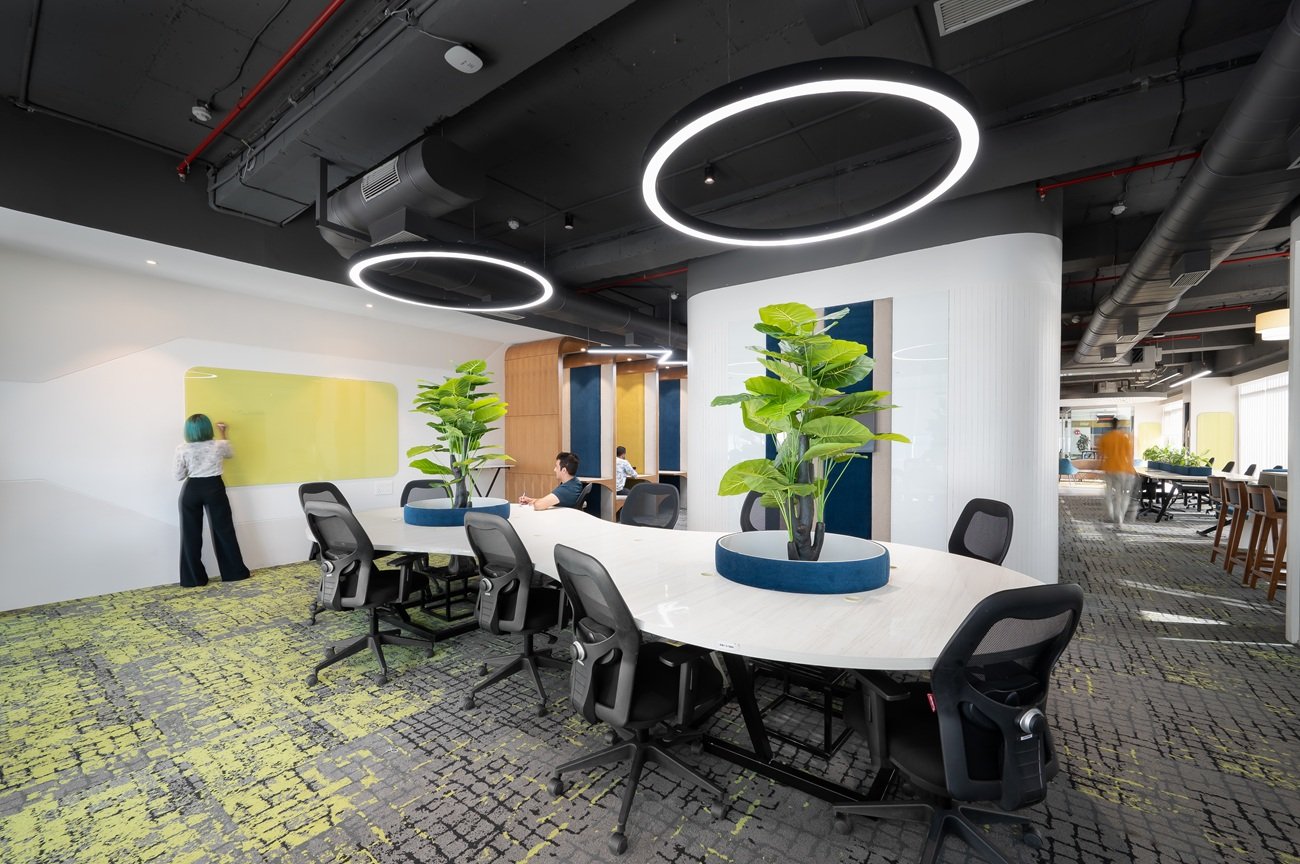
Contemporary office fit-out, done well, looks more like a curated collection of environments than a single typology repeated across a floor plate:
- Focus zones: acoustically treated, visually settled, designed to hold attention
- Collaboration hubs: flexible furniture, writable surfaces, integrated AV, built for the kind of thinking that requires other people
- Social anchors: pantry areas and lounge seating that make the informal conversations worth showing up for
- Restorative pockets: biophilic corners, quiet rooms, the small retreats that make sustained performance possible
Space utilisation in modern workplace design is about making sure each metre is doing something purposeful and that the person using it knows exactly what that purpose is.
The Sensory Layer
Walk into a lobby at the Four Seasons, and the lighting does not feel like lighting. It feels like the time of day has been carefully managed on your behalf. The materials don’t announce themselves. They simply make everything feel considered.
This is the hardest thing to explain to a client who is looking at a budget line item called “finishes” and the most important. The atmosphere is the cumulative effect of a hundred decisions that each influence how a person feels in a space, and therefore how they think, collaborate, and perform within it.
For office interior designers working within this framework, the decisions are specific:
- Lighting moves from overhead fluorescent uniformity to layered systems, ambient, task, and accent that shift the character of a space across the day
- Material contrast manages acoustic energy without the sterility of pure absorption; hard surfaces animate, soft surfaces settle
- Biophilic elements like natural materials, greenery, and borrowed views have documented effects on cortisol levels and sustained attention
- Colour temperature and palette shift between zones: warmer, more social tones in gathering spaces; cooler, more neutral registers in areas designed for deep focus
In a sustainable workplace context, material choices carry an additional dimension. Embodied carbon, lifecycle performance, and sourcing transparency are increasingly part of the brief for ESG-aligned organisations, and hospitality-influenced design is well-placed to meet that standard, because it already demands quality over quantity.
Building for Adaptability
The most resilient hotels are the ones that can transform without reconstruction. A ballroom becomes a boardroom. A breakfast room becomes an afternoon co-working space. The infrastructure is designed to flex, because the operators know they cannot predict every future demand.
It is a lesson that commercial interior design is learning quickly. What today’s talent demands from their workplace will not look the same in three years as it does today, and a fit-out built entirely around present-day assumptions will start showing its age well before its lease does.
Future-ready office design specifies adaptability from the outset:
- Demountable partitioning that evolves with headcount and team structure without requiring full fit-out cycles
- Modular, mobile furniture that can be reconfigured by a facilities team in an afternoon, not a contractor over three weeks
- Distributed power and data infrastructure that liberates working positions from fixed points on a floor plate
- Technology integration that is built into the architecture rather than bolted on, so hybrid collaboration works as designed rather than as a workaround
For commercial interior designers working with mid-size corporate clients, this is the difference between a space that earns its value over a decade and one that needs rethinking after five years.
The Question Worth Asking
Hotelification is about making them more intentional, more honest about what draws people in and what keeps them present once they arrive.
When organisations design their office with the same strategic care that a hospitality brand applies to its guest experience, the results follow. Attendance climbs. Culture deepens. Performance becomes something the space actively supports rather than quietly undermines.
The question is not whether your office should feel this way. It is whether it already does, and if not, what it’s costing you that you haven’t yet accounted for.
Ready to rethink your workplace from the ground up?
Studio AsA partners with corporate occupiers and property developers across Pune to deliver workplace design and commercial interiors that are as functional as they are considered. From initial strategy through turnkey delivery, we bring the full depth of our expertise to every brief.
Contact Studio AsA to schedule a design consultation and find out what a future-ready office looks like for your organisation.