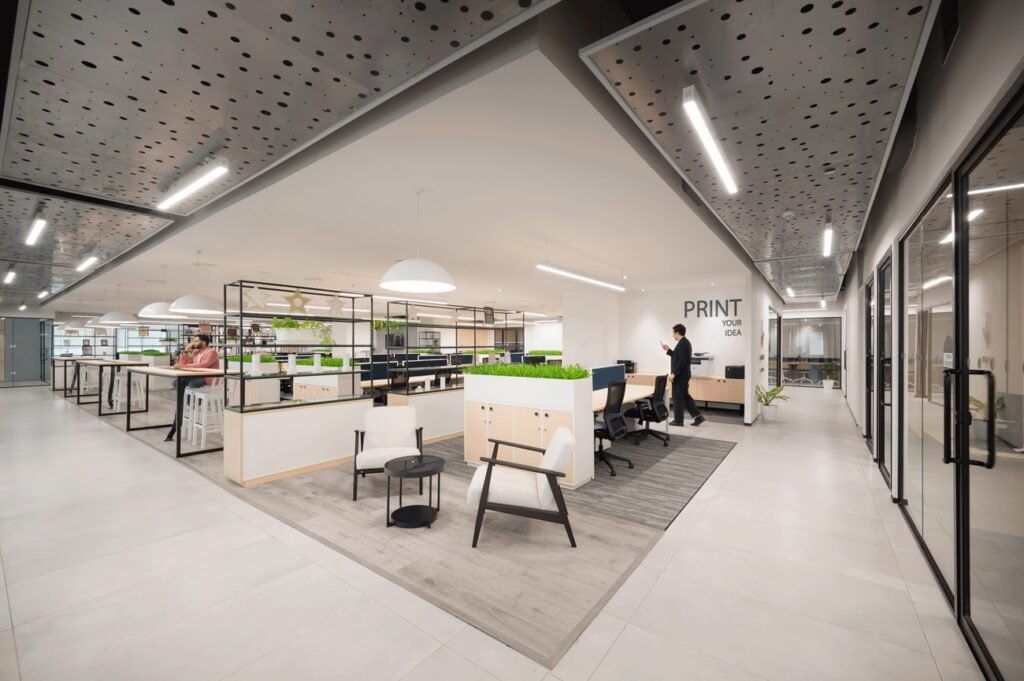


Every year, organisations spend millions redesigning offices. New furniture systems, fresh palettes, a cafe-style breakout zone. The ribbon is cut. Leadership is pleased. And within eighteen months, utilisation surveys tell the same quiet story: people are not using the space the way anyone intended.
This is not a strategic failure. The design was never connected to what the organisation actually needed people to do, feel, and become inside that environment.
The Gap Between Design Deliverables and Human Outcomes
Architecture has always measured itself in square metres, construction cost, and net lettable area. These are important numbers. But they are input metrics, not outcome metrics. They tell you what was built, not whether it worked.
Research into high-performing workplaces consistently points to the same finding: the organisations whose spaces generate measurable returns in productivity, retention, innovation, and culture are those that began the design process with a different kind of question. Not “What do we need?” but “What do we want our people to be able to do and who do we want them to become at work?”
The Problem with “Best Practice”
Best practice is borrowed logic. Activity-based working, biophilic design, and neighbourhood seating, these are frameworks that emerged from specific organisations solving specific problems. When they are transplanted wholesale, without understanding the underlying human conditions they were designed to address, they become expensive furniture arrangements.
For example, the open-plan office works best when both focus and collaboration are in the right proportions, at the right moment, for the right person.
What Outcome-Led Design Actually Means
At Studio AsA, we work from the premise that every square metre of a workplace should be traceable to a strategic intention. Not a vague aspiration (“we want collaboration”), but a specific, measurable human outcome: the kind that can be observed, surveyed, and refined.
This means the design brief is not a document that arrives before design begins. It is a living artefact, built through listening to leadership, to teams, to the individuals who will inhabit the space daily and whose relationship with that environment will shape whether they stay, contribute, and grow.
Space planning follows this work. Not the other way around.
Where Most Briefs Break Down
The brief fails most often at the intersection of aspiration and accountability. Leadership articulates a vision, “we want a space that drives innovation,” but that vision is never stress-tested into design criteria. What does innovation require spatially? Proximity between disciplines? Visual access to shared information? Permission to work in ways that feel informal? All of the above?
Without this translation layer, designers are solving for the atmosphere. They are producing an aesthetic interpretation of a cultural ambition. The result can be beautiful. It will rarely be transformative.
The Studio AsA Approach
We treat every workplace project as a hypothesis about human behaviour. The design is an experiment. Occupation data, post-occupancy evaluation, and ongoing conversation with the people inside the space are how we test and refine that hypothesis over time.
This is not a radical idea. It is simply rigour applied to an industry that has long been more comfortable with inspiration than with evidence. The built environment shapes behaviour at a scale that very few other interventions can match. That influence carries a responsibility: to design with intention, to measure with honesty, and to remain accountable to the humans the space was always meant to serve.
Your next workplace project deserves a brief that begins there.
Let’s talk about what your next spaces need – Start conversation