

The modern workplace is no longer defined by square footage. It is defined by performance.
Today, you are asking more of your office than ever before. You want innovation without distraction. Collaboration without chaos. Transparency without exposure. The challenge is not choosing between privacy and collaboration, it is designing an environment where both coexist, intentionally and seamlessly.
At Studio AsA, we believe inspiring workplaces are built on a simple truth: people perform best when they have control over how and where they work. The real question is not whether to prioritize privacy or collaboration but how to calibrate both to support focus, trust, and agility.
Here is how we approach that balance.
1. Design for Choice
High-performing teams are not static. Their spatial needs shift throughout the day, from deep focus in the morning to co-creation in the afternoon and confidential conversations in between.
We advocate for a layered ecosystem of spaces:
- Quiet focus zones with acoustic control and visual shielding
- Open collaboration hubs that encourage spontaneous exchange
- Enclosed meeting rooms for structured dialogue
- Micro retreats for quick, private calls
- Project rooms that allow teams to think visibly over time
When employees can choose the right setting for the task at hand, productivity improves and friction reduces. If you are rethinking spatial allocation, our perspective on Rethinking Office Layouts and Organizational Hierarchy offers further insight into how layout decisions directly shape performance behaviors.
2. Privacy Is Psychological Safety
Privacy in the workplace is often misunderstood as separation. In reality, it is about psychological safety.
Employees need environments where they can think deeply without interruption, hold confidential conversations without hesitation, and process information without constant visibility. Without these moments of retreat, cognitive fatigue rises and creativity declines.
We approach privacy across three dimensions:
- Acoustic privacy: Sound-absorbing materials, ceiling systems, soft furnishings, and white noise strategies that reduce distraction. Read more about the need for acoustics in office design.
- Visual privacy: Thoughtful sightline planning, translucent partitions, and zoning that protect concentration without creating barriers.
- Territorial privacy: Personal storage and assigned anchors that give employees a sense of ownership within flexible office interiors.
When privacy is embedded at multiple scales, collaboration becomes more meaningful because people engage from a place of clarity rather than exhaustion.
Collaboration Requires Intentional Friction
Open offices promised collaboration. What many delivered was a distraction.
True collaboration is not about proximity alone. It requires environments that signal purpose. A brainstorming lounge should feel different from a touchdown desk. A strategy session room should support both analog and digital thinking. Informal spaces should encourage relaxed conversation without interrupting focused zones.
We design collaborative environments with:
- Writable surfaces that extend thinking vertically
- Flexible furniture that adapts to group size
- Integrated technology that removes barriers to hybrid participation
- Spatial cues that indicate duration and intensity of use
When collaboration zones are clearly defined and acoustically buffered, they energize the workplace rather than disrupt it.
For organizations measuring impact, our insights on Workplace Strategy and Performance Metrics outline how spatial decisions directly influence engagement, utilization, and innovation outcomes.
4. Transparency Without Exposure
Many organizations aim to create transparent cultures. Glass partitions, open sightlines, and visible leadership spaces are often used to signal openness.
We introduce layered transparency:
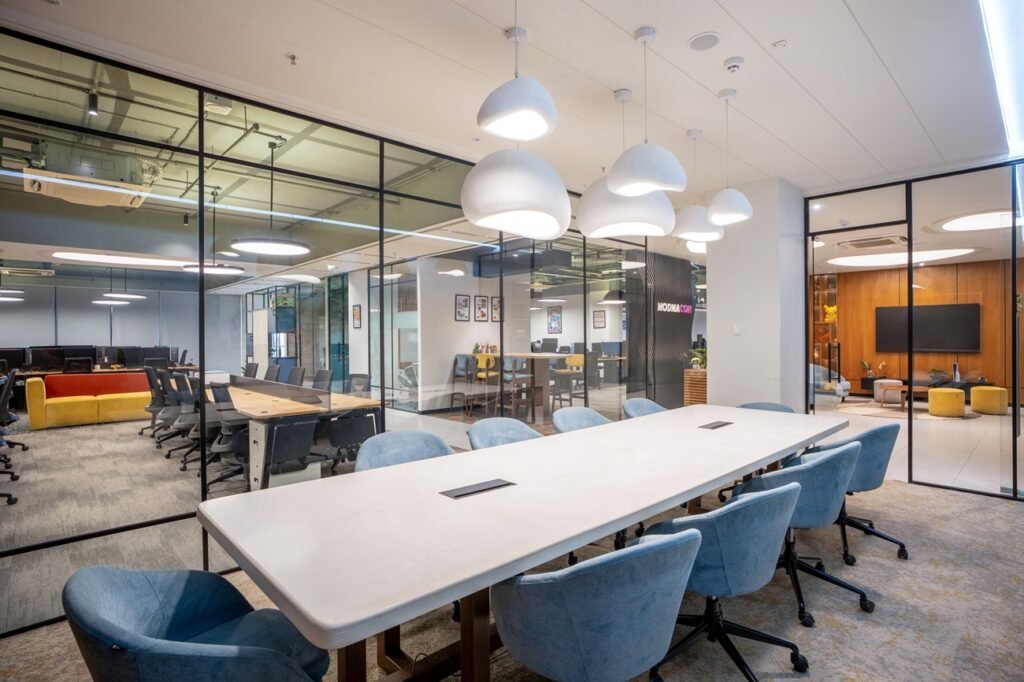
- Frosted or fluted glass that diffuses views
- Partial-height partitions that maintain connection without distraction
- Strategic placement of enclosed rooms at perimeter zones
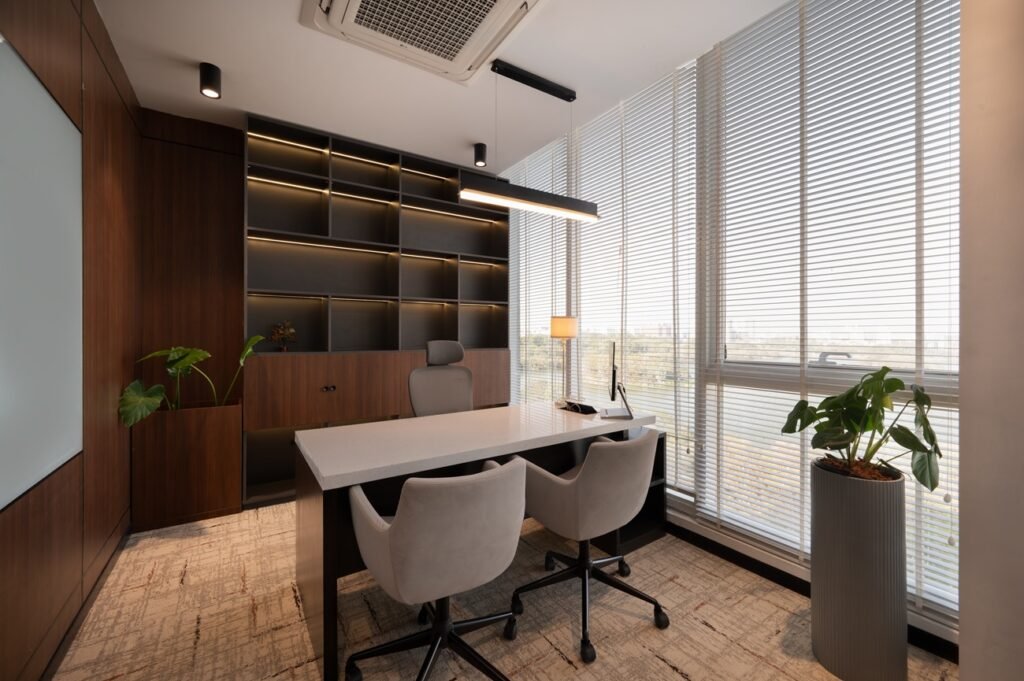
- Leadership spaces that are accessible yet acoustically protected
This approach reinforces trust while respecting the need for discretion. It communicates accessibility without sacrificing confidentiality.
5. Data-Driven Zoning
Balancing privacy and collaboration is not guesswork. It is evidence-based. Before designing, we analyze workstyle patterns, meeting durations and frequency, focus time requirements, team adjacency needs and hybrid occupancy data.
Often, organizations overestimate the need for large meeting rooms and underestimate demand for small, private focus rooms. Others create abundant collaboration zones but neglect acoustic buffering.
Data allows us to rebalance square footage in ways that align with real behavior rather than legacy assumptions.
If you are exploring workplace transformation, our thinking on Designing for Transparent Workplace Cultures expands on how physical space reinforces cultural intention.
Performance follows alignment.
Culture Is the Final Layer
No spatial strategy succeeds without behavioral clarity.
Policies around booking rooms, noise etiquette, hybrid participation, and leadership modeling shape how effectively privacy and collaboration coexist. Design sets the stage but workplace culture directs the performance.
We encourage organizations to:
- Define collaboration norms
- Establish focus hours
- Model inclusive hybrid behaviors
- Train teams on spatial intent
When people understand the “why” behind design decisions, they use spaces as intended.
The Future Is Balanced
The conversation is no longer open plan versus private offices. It is about creating dynamic ecosystems where privacy and collaboration are in constant dialogue.
In high-performance environments, employees move fluidly between solitude and teamwork. They can concentrate without isolation. They can collaborate without chaos. They feel visible without feeling exposed.
If you are evaluating your workplace, ask yourself:
- Do your employees have a meaningful choice?
- Are collaboration zones clearly supported and acoustically protected?
- Is privacy embedded at multiple levels?
- Does your layout reflect how work actually happens today?
At Studio AsA, we design workplaces that empower people to do their best work together and individually. Because when environments are thoughtfully calibrated, performance becomes a natural outcome.
And in the future of work, balance is essential.
Connect with our team to design your workplace.